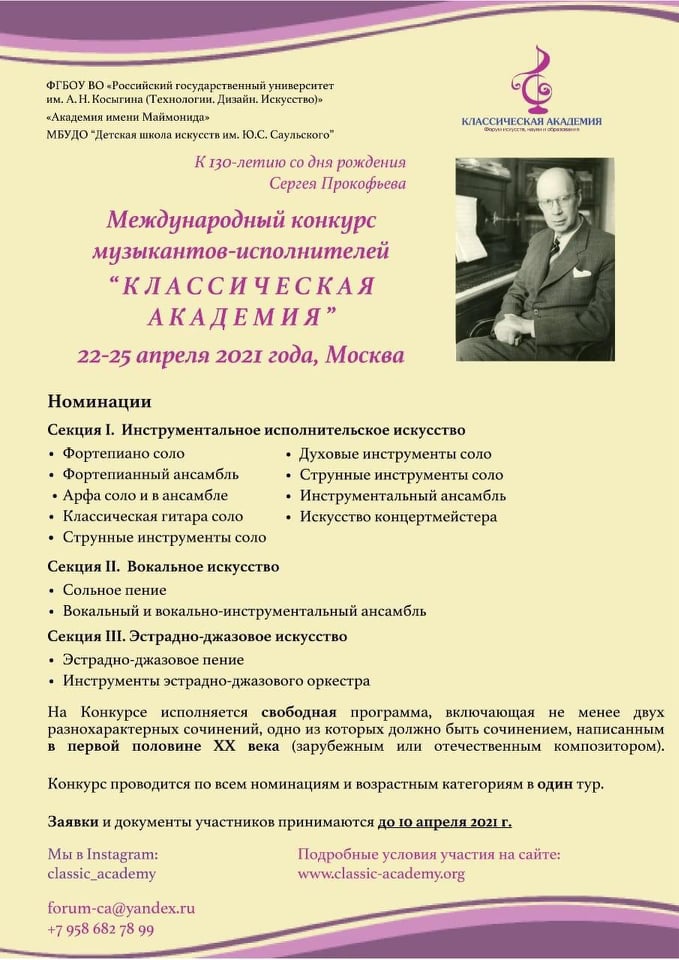
On April 22-24, a significant event took place in Moscow -
the II International Scientific Conference "Musicology: Art. Culture.
Education”, organized by the Institute “Maimonides Academy”. I had a chance to
participate as an independent researcher in this large-scale conference, which
brought together musicians, art historians, philologists from different parts
of Russia and the world.
Here is my video presentation -
"The Art of Interpretation: Artistic Analysis of the Piano Concerto No. 2
op. 16 (in G Minor) by Sergey Prokofiev."
22-24 апреля в
Москве прошло знаменательное событие - II Международная научная-практическая конференция «Музыкознание: Искусство. Культура.
Образование», организованная Институтом «Академия имени Маймонида» РГУ им. А.Н. Косыгина. В этом масштабном мероприятии, собравшем музыкантов, искусствоведов, филологов из разных уголков России и мира, мне тоже посчастливилось принять участие в роли независимого исследователя.
Представляю свою видео-презентацию на тему «Искусство интерпретации: художественный анализ Концерта для фортепиано с оркестром №2 (ор.16, g-moll) Сергея Прокофьева». На примере Второго концерта Прокофьева поговорим о художественной составляющей в процессе работы над музыкальным произведением, о том, что стоит за нотным текстом.
Philippe Mathis first worked as pianist in Paris and for a famous agency in Geneva. He used to play during ten years mainly jazz and international music in Europe, Monaco and Asia.
Even after he left the music business, he always enjoyed writing his compositions. One of his goal is not only to write music for piano but the also music that the pianist would enjoy performing.
His piano compositions have received several international awards in competition. Most of them are written for solo piano and can be played live. You can download on the site the pdf scores of these main compositions and also listen to his music.
So when a lucky coincidence reacquainted our families after nearly 50 years, we traded musical discoveries, his accomplished compositions and Svetlana's performances and Antoine's music.
Michael Conway Baker.
Sonata for piano ор. 31 (1975)
Sonata for piano by a renowned
Canadian composer starts on a peak of intensity suggesting a tragic moment.
This high energy one movement piece raises the eternal philosophical theme -
the struggle between good and evil, where the battlefield, to paraphrase
Dostoevsky, is a human’s heart.
Майкл Конуэй Бейкер. Соната для фортепиано ор. 31 (1975)
Соната канадского композитора Майкла Конуэй Бейкера (1937-) начинается с
точки высокого напряжения. Это одночастное сочинение, наполненное мощной
энергетикой, поднимает извечную философскую тему борьбы добра и зла, где,
перефразируя Достоевского, поле битвы – человеческое сердце.