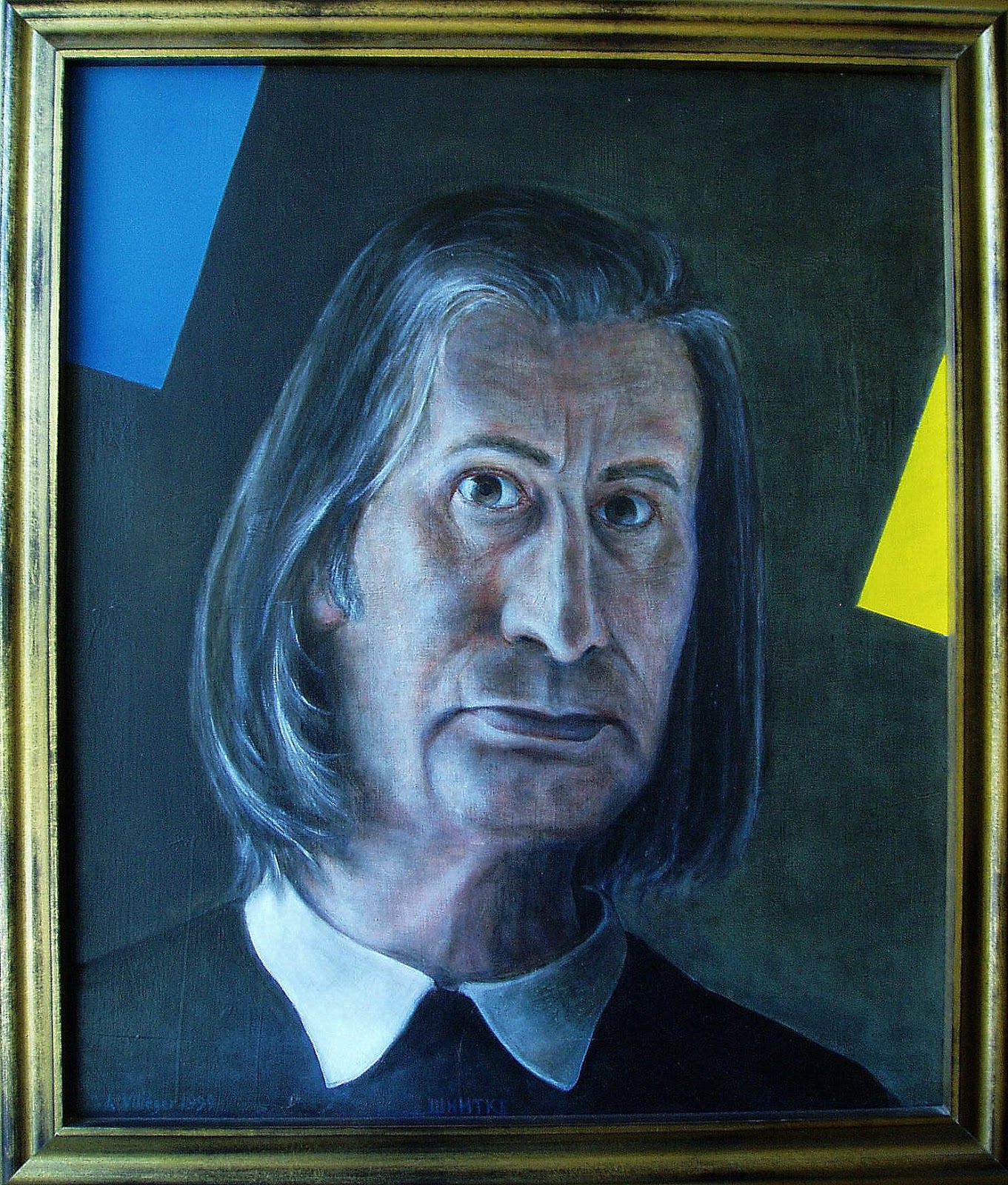
This guest post is an essay by my husband, Marc Vill
éger on Michael Morreale's CBC Music post entitled
"Lang Lang on why the world still needs classical music"
“Why the world STILL needs classical music?”
Under this simple question, and in view of the resounding silence that greeted the news of Galina Vishnevskaya’s passing in most Anglophone Canadian media, an entire conception of “classical music” is at stake.
Let me first answer the obvious quickly: if under classical music one understands the supremely refined expression of the human soul through an ever evolving, complex language which evolution witnessed the rise of the occidental civilization, then, only when humans disappear will the need of it vanish. Just as for any art form, anywhere. So the answer is yes, of course, just as we need air in our lungs, next?
However, this question cannot be taken out of its context that is, the cheesy interview of a superstar, on a network that, not unlike the protagonists, has proven privileging form over substance. In fact “classical music” these days is unduly stretched between two seemingly mutually exclusive definitions by the servants of officialdom: an expansive one and a fossilized one, the later enabling the former through a supposed legitimate need for democratization.
Indeed, what is it these days that classical music should become such a wide umbrella to accommodate everything and anything remotely connected, such as lush violins scoring, or vague symphonic paraphrasing? You’d never hear Schnittke’s Requiem claiming to be Rock & Roll because it incorporates an electric guitar in its orchestration! But infuse any pleasing melodic line in the middle of some Hollywood flick and legions will gleefully rush into labeling it “classical”, giving the tune an aura of respectability.
Yet suggesting the broadcast of Shostakovich or Britten, a 50 year old art music to a wide audience as an illustration of the importance and the relevance of Vishnevskaya’s life in our post World War 2 culture is suddenly met with veiled accusations of elitism, the usual sin, star system enforcers accuse the cognoscenti of, in order to mask their own self serving cliquey behavior.
Is this a coincidence, that the over-engaging host’s program is introduced as “… Canada's classical companion that shares beautiful music and engaging stories that inspire, inform and uplift. It takes listeners into the heart of the classical music repertoire”?
Beautiful, heart of the classical repertoire are sweet euphemisms for the virtual obfuscation of the post 1950 repertoire, only to be replaced by a crossover between New Age greenery and ad hoc social engineering, surfing on the social media superficiality, untouchable ideological icons. “Easy listening” curiously rules in our complex world, a difficult and unpredictable world, which was anticipated by many second half of 20th century classical composers, who often paid a personal price for speaking the truth.
Enabling the “Big Easy”, is the fossilization of the genre (nothing posterior to 1950, the big Bs etc…) encouraged by media and presenters, frightened to lose their grey hair public and eager to attract young blood, often stereotyped as indiscriminate. Fossilization went hand in hand with the “ghettoization” of classical music, which is the fragmentation of its performing delivery along period lines, Baroque, Classical, Romantic, and Modern eras. This way, any hint of evolution is forever lost to audiences as if the medium had already died, back then, as if “Rite of Spring” or Rachmaninov’s piano concerti sounded its obituary.
Meanwhile, in a seemingly paradoxical twist, but in fact, a supremely pedantic move destined to show the masses that they are the arbiter of musical taste, the musicological and broadcasting elite has been praising unreservedly the fringe of experimental avant-garde music of the past 50 years, designated as THE sole exponent of contemporary classical music. As if our demagogues needed an exception to confirm their rule, as if they needed to chose musical creation’s most intellectualist attempts to uproot any chance by a large audience to connect with today’s classical music while forging an artificial respect not dissimilar to that of speaking Latin during Mass among the non enlightened plebe.
But even this dismemberment is not enough or is it that the strategy is finally bearing fruits, boring even its staunchest supporters? Not satisfied with eliminating among others, Schnittke (whose symphonies have reflected on the history of western classical music), Dutilleux, Gubaidulina, Ligeti, Vasks, Silvestrov, the sensitive Nicolas Bacri or Bruno Mantovani, whose orchestral magic is worthy of a 21st century Ravel, it is now time to purge the classical moribund. So instead of focusing on meaning and relevance, and feature this banished repertoire played by specially perceptive artists, interpreters –not necessarily the superstars-, the business and its cheerleaders clung to their old turf. While the clique figured that branding anything commercially successful “classical” should resuscitate the patient in one hand, on the other, they also brought “critical” questions to the forefront in a bid to analyze the illness they inoculated him with. Hence all these made up controversies about the attire of musicians, of the public, the need for wide screens, the clapping or not issue. Anything but fundamentals! Reality is the enemy.
Finally now, after this musical journey, we can better appreciate the insidious modulation introduced by the word “still” in the formulation of the question. “Why the world still needs classical music?” asks the journalist. “Still” suggests not the air we breathe, the Art that feeds and reflects the human soul… No! “Still” frames the question in an unambiguous way: do we still require Art or do we simply accept its entertaining caricature that makes the mob happier, the radio soprano smoother and the superstar richer? The art of substitution! The question reveals in fact a disguised ultimatum: accept our definition of “classical music”, this dismantled, chopped off remnant of western civilization in its new easy uniform or face relegation to the fringe, behind a renewed wall of radio silence, and stage oblivion.
Although, our opinion appears to be sought, they look forward to a plebiscite in favor of their crime.
So does the world still need classical music?
My answer is no.
Dr. Marc Villéger
Illustration: Portrait of Alfred Schnittke, by Marc Villéger (1999)
P.S. June 04, 2013: French composer Henri Dutilleux passed away on Wednesday May 22, 2013. CBC Radio 2 Katherine Duncan quickly put out a
blog post on May 23, linking to the New York Times obituary and some YouTube interview involving New York Philharmonic's music director Alan Gilbert.
Yet according to CBC broadcast logs, almost two weeks after the news, neither her program
"In Tune" nor the two main classical programs "
Tempo" and "
In Concert" could manage to find the time to play ANY piece by Dutilleux on the Radio 2 waves! Nothing, despite even having DG release a premiere recording of Dutilleux's 2003
"Correspondances" featuring a Canadian Soprano, Barbara Hannigan.
QED.
P.S. 2 16 April 2019: As I predicted, Canadian
audiences who had been starved of late 20th century music both in the concert hall
and on the radio were going to be peddled at one point in time "new" but
most importantly, for the promoters, Canadian compositions while praising the creativity of the new works...
It seems this time has come. Take this "Baroque melting" (2017)
by no less than Juno award-winning Edmonton born Vivian Fung...
Fortunately for some of us, Maestro Mario Bernardi when he served as Music Director of the Calgary Philharmonic Orchestra did introduce
Schnittke's Concerto Grosso No.3 (1985) to his audience in the early 90s.
Now I am asking: who will know in today's audience the uncanny
kinship between the 2017 composition and the 1985 one? Especially, since the
Canadian composer did not care to reference Schnittke's polystylistic major body of works in general and that concerto grosso in particular...
Are we to now expect that plundering Schnittke's music will provide many other Canadian premieres? How can we then trust a composer, his or her unique voice? Can we hope the across the board policies of musico-cide will be reversed anytime soon? When will a full history of late 20th century classical music be finally getting exposure and shared by our public broadcaster and our symphony orchestras so lineage of works and ideas is understood?